



























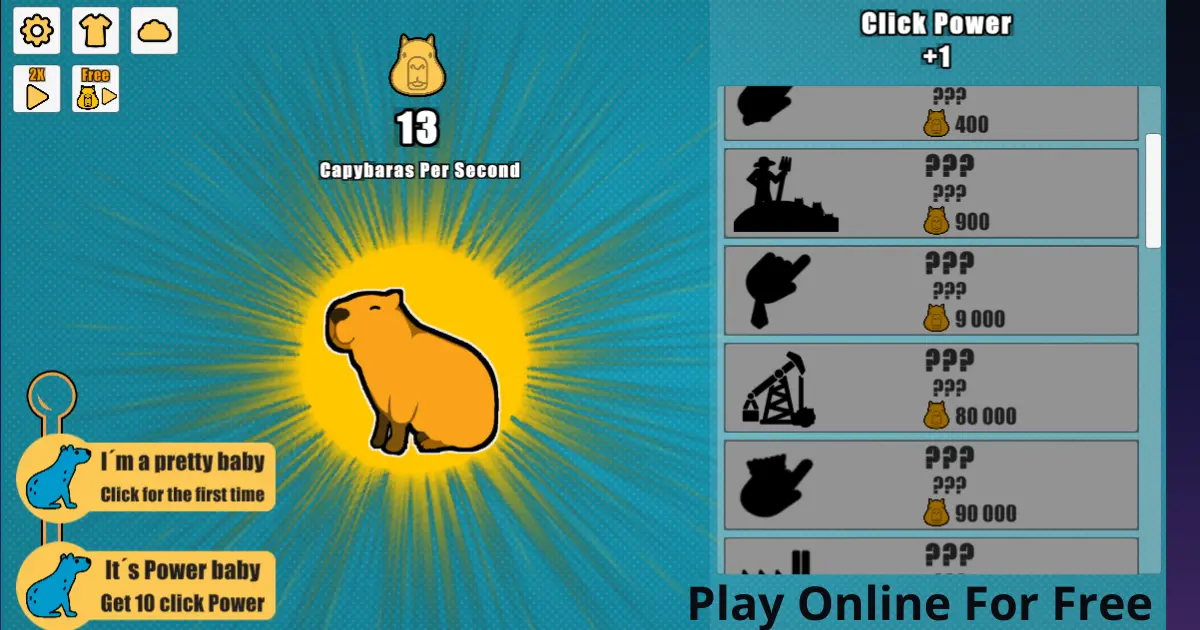
Capybara Clicker is a simple, satisfying clicker where your job is to generate as many capybaras (or capybara points) as possible, then reinvest that output into upgrades that snowball your production. It is easy to start and surprisingly easy to waste progress if you buy the wrong boost at the wrong time.
Play Now: Jump in and start clicking, then come back here once your first upgrades unlock.
Because it is a lightweight online/browser game, Capybara Clicker typically runs in a modern HTML5-capable browser on desktop or mobile.
Key Features
- Fast core loop, click to earn, buy upgrades, then watch output scale up.
- Idle progress style pacing, your production continues even when you stop clicking.
- Simple upgrade math, multipliers, flat bonuses, and automation upgrades to balance.
- Short feedback cycles, you feel gains within minutes, not hours.
- Cosmetic variety in most versions, skins or backgrounds may unlock as you progress.
- Quick reset friendly progression, prestige-like loops may exist in some builds.
What is Capybara Clicker?
Capybara Clicker is a clicker and idle game built around one repeating loop: generate currency by tapping, then spend that currency on upgrades that increase how much you earn per click and how much you earn passively over time. The tactical dynamic is deciding when to actively click for bursts versus when to let idle income do the heavy lifting.
What makes it different from many generic clickers is how quickly early upgrades change your pace. A single smart purchase can double your output, while a “fun” cosmetic buy too early can stall you. If you are searching for Capybara Clicker 1 or Capybara Clicker 2, the exact upgrade names can vary, but the decision patterns stay similar.
How to Play
Your goal is to increase your total production as efficiently as possible. You start with manual clicking to earn your first currency. As soon as upgrades appear, you begin balancing three things: earnings per click, idle income per second, and multipliers that scale both.
Win and lose conditions: Most clickers do not have a traditional “game over.” Instead, the fail state is inefficient spending that slows your growth. If a version includes timed events or short challenges, the “loss” is usually failing to reach a target before the timer ends.
Progression: Progress typically ramps through upgrade tiers. Early game is click heavy, mid game becomes mostly idle with occasional spending, and late game focuses on multipliers, automation, and possible resets (if a prestige system exists in that build).
Controls (common browser layout):
Controls
To generate currency, left-click or click the tap area on desktop, or tap the main button on mobile.
To buy upgrades, click the upgrade button on desktop or tap the upgrade button on mobile.
To open menus (shop, skins, settings), click icons or tabs on desktop or tap icons or tabs on mobile.
To confirm a purchase or toggle an option, click confirm or a checkbox on desktop or tap confirm or a toggle on mobile.
Micro experience cue: If your clicks stop feeling meaningful, shift spending toward idle income for a few minutes.
Micro experience cue: If a multiplier upgrade appears and you can afford it without emptying your bank, it is usually worth prioritizing.
Core Gameplay Mechanics
1) Main system (When you do X, the game does Y): When you click the main capybara button, the game awards currency based on your current “per click” value. When you buy upgrades, the game increases per click, per second (idle), or both through multipliers. The loop is spend currency to raise earning rates, then use the higher rate to afford the next tier faster.
2) Tactical dynamics (When you see Z, do A): When you see upgrades split into flat boosts versus multipliers, treat them differently. Flat boosts help you break early price walls, while multipliers carry your growth longer. When the next upgrade is barely out of reach, do a short focused clicking burst, then return to idle once you hit the purchase.
3) Progression and scaling: As prices rise, single purchases matter less unless they scale with multipliers. In most versions, the economy is tuned so early upgrades feel cheap and frequent, then you hit “walls” where waiting becomes normal. Your job is to smooth those walls by buying the most cost-efficient upgrade, not the most expensive one.
4) Key elements (resources, hazards, timers, fail states): Your key resources are currency, upgrade tiers, and any temporary boosters (for example, short-duration multipliers). The main hazard is spending down to zero right before a multiplier tier, which delays your next big jump. If a version has timed boosts, do not trigger them right before you need to step away.
Decision Flow (Quick Win Rule)
Can you afford a multiplier upgrade? If yes, buy it, then click 10 to 20 seconds, and re-evaluate the shop.
If no, is an idle upgrade within 1 minute? If yes, wait for idle income, buy the idle upgrade, then save toward a multiplier.
If no, perform a click burst, buy the best flat boost, and build an idle base.
Strategies
- Multiplier First Pass: Buy multipliers as soon as you can afford them without draining your currency to zero. Multipliers usually scale both clicking and idle gains, so they compound future purchases faster. Warning: if a multiplier is overpriced early, take one flat boost first to avoid stalling.
- Idle Floor Setup: Before you chase expensive tiers, build a reliable idle income floor so waiting is productive. Aim for a point where 30 to 60 seconds of idle time buys a meaningful upgrade. Why it works: it reduces reliance on constant tapping. Warning: do not overbuy idle if click value is still tiny.
- Burst to Break Walls: Use short clicking bursts only when a key purchase is close. For example, if you are within a small gap of a multiplier, click for 15 to 30 seconds, buy it, then stop. Why it works: it converts effort into a lasting rate increase. Warning: long bursts waste time once idle dominates.
- Do not Zero Your Bank: Keep a small currency buffer instead of spending everything each time. This helps you react to sudden “best value” upgrades when they appear or become affordable. Why it works: it prevents dead time after purchases. Warning: hoarding too much is also a slowdown, spend when value is clear.
- Upgrade Efficiency Check: Compare upgrades by what they add per cost, not by their label. If one upgrade adds 10% output for 1,000 and another adds 5% for 900, the first is better. Why it works: clicker economies reward efficiency. Warning: in some versions, hidden synergies can change this.
- Boost Timing Discipline: If you get temporary boosts (like x2 for a short time), trigger them when you can actively click and buy several upgrades during the window. Why it works: you stack boosted earning with fast reinvestment. Warning: do not waste boosts when you are about to leave the device.
Similar Games
- Tiny Fishing 2
- Idle Fishing
- Fish Orbit
- idle fishing
If you want a different pace than this online/browser game, you may also enjoy more Clicker and Idle games.
FAQs
What platforms is Capybara Clicker available on?
Capybara Clicker is commonly available as an online/browser game, and some versions also exist as mobile apps. If you see listings like Capybara Clicker Poki, Capybara Clicker Crazy games, or Capybara clicker msn, those are different portals hosting a browser build. Availability can vary by region and store.
What is the objective of Capybara Clicker?
The objective is to generate as much currency as possible and use it to buy upgrades that increase your production. There is usually no hard “end,” the goal is efficient growth. In most versions, your success is measured by how quickly you reach new upgrade tiers and how smoothly you pass price walls.
What are the upgrades in Capybara Clicker?
Upgrades typically include boosts to earnings per click, boosts to idle earnings per second, and multipliers that scale your overall output. Some versions add temporary boosts, automation, or cosmetic unlocks. If you are comparing Capybara Clicker 1 and Capybara Clicker 2, the names may differ, but the upgrade categories are usually similar.
What are the features of Capybara Clicker?
Common features include a tap-to-earn loop, an upgrade shop, idle progression, and occasional cosmetics like skins or backgrounds. Many builds also include simple settings for sound and performance. If you are looking for Capybara clicker Scratch, note that Scratch versions are often simplified and may not match portal builds.
What are the gameplay mechanics of Capybara Clicker?
The mechanics revolve around compounding: clicks and idle income generate currency, and purchases increase your earning rates, which lets you afford stronger purchases. The main skill is upgrade timing and efficiency, not reflexes. If you keep hitting slowdowns, it usually means you are buying low-impact upgrades too often.
Technical
Capybara Clicker is typically an HTML5 game and may use WebGL depending on the build. It should run in current versions of Chrome, Firefox, Safari, or Edge. Most mid-range devices should handle this online/browser game smoothly, but performance can dip if a version uses heavy animations or lots of particles.
On desktop, it is usually mouse-driven clicking with simple UI buttons. On mobile, it is tap-based with larger buttons. If you are playing in a browser, there is usually no download required. If you are searching for Capybara Clicker download, that often refers to store apps or offline builds rather than the browser version.
Note: Labels like Capybara Clicker Pro, Capybara Clicker 2, or Capybara Clicker 1 can refer to different editions or portal listings, so saving and offline behavior can differ. If your progress does not persist, look for an in-game save option or a portal account login.
If you want more relaxed management-style games, explore Simulation.
If you prefer faster, short-session games, explore Arcade.
Final Verdict
Capybara Clicker is a clean, low-friction clicker that works well when you want steady progression, quick decisions, and satisfying compounding. Its strengths are the simple core loop, clear upgrade impact, and the way it fits into short sessions as an online/browser game. Its limits are typical of the genre: if you dislike waiting or incremental math, the mid-game walls can feel slow.
It is best for players who enjoy optimization, light resource management, and relaxing progression in an HTML5 game format. Use the guide above to prioritize multipliers, set a stable idle floor, and avoid spending yourself into dead time.
Play, upgrade smart, and keep your boosts for moments when you can actively reinvest.